
Global Medical Foundation Models Market 2026 – 2035
Report Code
HF1169
Published
August 3, 2026
Pages
220+
Format
PDF, Excel
Revenue, 2026
4.18 Billion
Forecast, 2035
18.76 Billion
CAGR, 2026-2035
16.9%
Report Coverage
Global
Market Overview
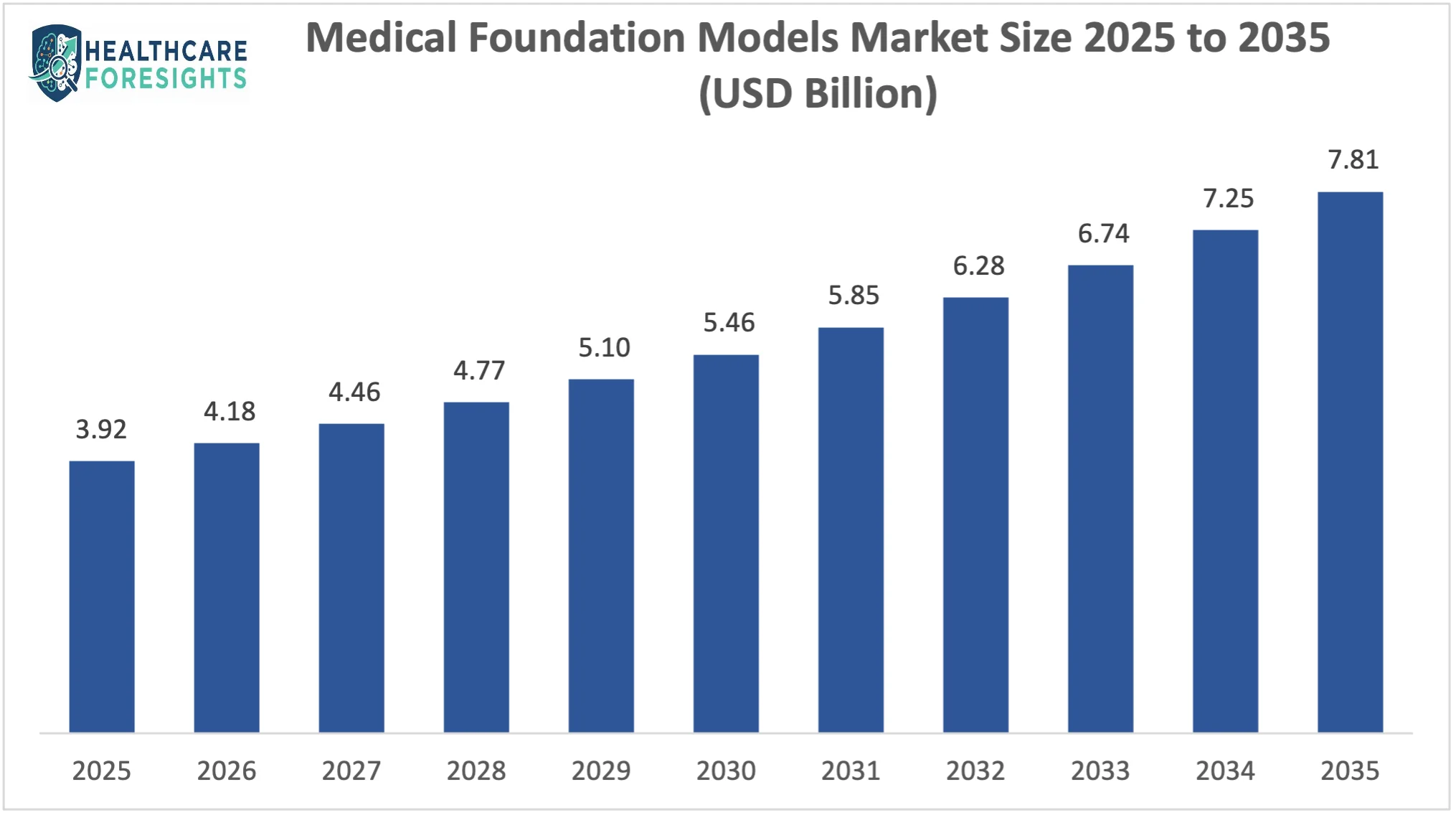
The global Medical Foundation Models market is projected to reach USD 4.18 billion in 2026 and is expected to expand at 16.9% CAGR to USD 18.76 billion by 2035. The North America region is projected to have ~44.8% market share of the global generative AI, large language models (LLMs), multimodal AI, and cloud-based healthcare AI platform market by 2025, which is primarily fueled by the adoption rate of these AI systems by hospitals, pharmaceutical companies, biotechnology companies, research institutions, and healthcare technology providers.
It is also home to state-of-the-art healthcare technologies, investments in AI research and development, and a growing number of organisations implementing Electronic Health Records (EHRs) and leading AI solution providers, cloud service providers, and life sciences companies. The rising adoption of medical foundation models in clinical decision support, medical imaging analysis, drug discovery, clinical documentation, precision medicine and biomedical research are driving the market growth.
Furthermore, the regulatory measures pertaining to responsible utilization of AI, growing collaboration among healthcare organisations and AI technology providers, and continued investments in the digital transformation of the healthcare industry solidify North America's dominance in the Medical Foundation Models market.
Market Highlight
Multimodal Foundation Models led the global Medical Foundation Models market in 2025 owing to their ability to integrate and process complex clinical information such as clinical text, medical images, pathology slides, genomic data, laboratory reports, and electronic health records (EHRs) to support complex clinical decision-making and precision medicine.
The demand for scalable AI infrastructure, high-performance computing, secure management of healthcare data, and seamless integration with EHR, PACS, laboratory information systems (LIS), and healthcare analytics platforms highlighted cloud deployment as a primary focus in 2025.
Transformer-based architectures played a significant role in the technology component of 2025 by providing high accuracy and scalability for large language models (LLMs), multimodal AI, clinical decision support, medical imaging analysis, drug discovery, and biomedical research.
In 2025, North America is expected to be the top region in the global Medical Foundation Models market, as it has many major AI technology providers, life sciences firms, and healthcare organizations, and higher investments in precision medicine, excellent healthcare systems, and higher adoption of generative AI.
Significant Growth Factors
The adoption of multimodal AI models is becoming ubiquitous in different clinical decision-making and healthcare workflows.
The application of multimodal AI models in clinical decision support and across the healthcare workflows is gaining momentum. The medical foundation models are being adopted across different sectors, including healthcare, pharmaceuticals, and research, for clinical decisions, medical imaging analysis, medical documentation, disease diagnosis, personalized patient care, and other applications.
It can process large volumes of healthcare data, including clinical text, medical images, pathology slides, laboratory reports, genomic data, and electronic health records (EHRs), allowing for the accurate interpretation of the clinical information and the automation of complex healthcare processes. Healthcare organizations are turning to medical foundation models at a faster pace, with investments in generative AI and precision medicine technologies. Increasingly connected with health care data systems and AI-driven drug discovery.
Integration with healthcare data platforms is growing, and so is drug discovery using AI.
The medical foundation models market is expected to generate significant opportunities due to the increasing investments in healthcare digital transformation, cloud computing, and biomedical AI infrastructure. Medical foundation models are progressively becoming interwoven with electronic health records (EHRs), laboratory information systems (LIS), picture archiving and communication systems (PACS), genomic databases, and knowledge graphs for healthcare.
Medical foundation models are now being integrated into electronic health records (EHRs), laboratory information systems (LIS), picture archiving and communication systems (PACS), genomic databases, and healthcare knowledge graphs, enabling intelligent clinical reasoning and AI integration across the enterprise.
Pharmaceutical and biotechnology firms are also using these models to expedite drug discovery, biomarker identification, clinical trial optimization and real-world evidence analysis. In the era of continuous innovation, the contribution of medical foundation models to the future of healthcare technology grows stronger through the steady progress of multimodal AI, large language models (LLMs), retrieval-augmented generation (RAG), and federated learning.
Driver Impact Analysis
Drivers | Estimated CAGR Impact | Regional Relevance | Market Impact |
Growing adoption of multimodal foundation models for clinical decision support and healthcare AI | +3.5% | North America, Europe, Asia Pacific | Accelerates deployment of AI-powered clinical reasoning, diagnostics, and personalized patient care |
Increasing investments in generative AI, large language models (LLMs), and healthcare digital transformation | +3.1% | North America, Europe, Asia Pacific | Expands enterprise adoption of foundation models across hospitals, pharmaceutical companies, and research institutions |
Rising demand for AI-driven drug discovery, biomedical research, and precision medicine | +2.7% | North America, Europe, Asia Pacific | Improves target identification, biomarker discovery, clinical research, and therapeutic development |
Growing integration with EHRs, PACS, genomic databases, and healthcare knowledge graphs | +2.3% | North America, Europe, Global | Enhances interoperability, healthcare data utilization, and intelligent clinical workflows |
Continuous advancements in multimodal AI, retrieval-augmented generation (RAG), and cloud computing | +2.0% | North America, Europe, Asia Pacific | Strengthens model accuracy, scalability, and real-time clinical decision support across healthcare ecosystems |
Restraints Impact Analysis
Restraints | Estimated CAGR Impact | Regional Relevance | Market Impact |
Data privacy, security, and regulatory compliance challenges for healthcare AI | -2.5% | Global | Increases compliance complexity and limits deployment of foundation models using sensitive healthcare data |
High computational infrastructure costs and GPU resource requirements | -2.1% | Global | Restricts adoption among small and mid-sized healthcare organizations with limited AI infrastructure |
Limited availability of high-quality, standardized, and annotated healthcare datasets | -1.8% | Global | Reduces model performance, generalizability, and clinical reliability across diverse healthcare settings |
Integration challenges with legacy healthcare IT systems and clinical workflows | -1.5% | Global | Slows enterprise-wide implementation and interoperability with existing healthcare platforms |
Shortage of skilled AI professionals, clinical informaticians, and healthcare data scientists | -1.3% | Asia Pacific, Latin America, Middle East & Africa | Delays model development, validation, deployment, and long-term optimization across healthcare organizations |
What are the Major Advances Changing the Medical Foundation Models market Today
The integration of Large Language Models (LLM) and Multimodal AI in Clinical Decision Intelligence.
Medical foundation models are changing healthcare through the use of large language models (LLMs), multimodal AI, and transformer architectures, which analyze medical data and interpret it across a variety of modalities, such as electronic health records (EHRs), medical images, pathology slides, genomics, laboratory reports, and clinical notes. Such models offer high-level clinical decision-making support, support medical documentation, create patient summaries, and support diagnosis and therapy planning. They can handle complex biomedical knowledge and are successfully incorporating multiple types of data to improve diagnostic accuracy, productivity of the clinician, and personalized care for the patient.
The Foundation Models are designed to drive drug discovery, clinical research, and precision medicine.
The fast development of foundation models is revolutionizing pharmaceutical research and precision medicine with enhanced capabilities to identify drug targets, discover biomarkers, predict molecular properties, and optimize clinical trials. The biomedical literature, genomic databases, proteomics data, real-world evidence (RWE), and clinical datasets are analyzed using AI-powered foundation models to observe and uncover novel therapeutic insights and support personalized treatment strategies. Pharma, biotechnology, and research institutes are picking up the pace in adopting it, which is decreasing the time to market for drugs, increasing research efficiency, and propelling innovation in the life sciences.
Cloud-based AI infrastructure and federated learning that enables scalable healthcare AI.
Medical foundation models can be securely deployed in hospitals, health care networks, and research organizations thanks to the emergence of cloud-native AI platforms, federated learning, and privacy-preserving AI. The modern platforms enable large-scale model training, continuous learning, real-time inference, and integration with other hospital and electronic health records systems (EHRs, PACS, laboratory information systems (LIS), and hospital information systems (HIS)).
Federated learning allows for development of a model without sharing sensitive patient information, with cloud infrastructure providing flexibility in scalability, interoperability, regulatory compliance, and enterprise-wide AI deployment. These developments are driving digital transformation, enhancing clinical processes, and driving the use of trustworthy and reliable AI in healthcare globally.
Category Wise Insights
By Model Type
What Makes Multimodal Foundation Models so Popular?
In 2025, the global Medical Foundation Models market was dominated by the Multimodal Foundation Models segment because it handles and analyses various types of medical data, such as clinical text, medical images, pathology slides, laboratory reports, genomic data, and electronic health records (EHRs). These models can be used for detailed clinical reasoning, better diagnostics, precision medicine, and better decision-making through the healthcare workflows. The hospital, pharmaceutical, and research sectors continue to drive the use of multimodal AI, further solidifying its position of leadership.
By Deployment Mode
So why is Cloud Deployment leading the market?
The Cloud segment accounted for the largest market share in the global Medical Foundation Models market in 2025, primarily due to the growing demand for scalable AI infrastructure, high-performance computing, and secure healthcare data management. Cloud platforms allow healthcare organizations to efficiently train, deploy and manage foundation models and to integrate with EHRs, PACS, laboratory information systems (LIS), genomic databases and health care analytics platforms. Adopting the cloud continues to gain momentum in healthcare ecosystems due to its lower infrastructure costs, its ability to scale quickly, and enterprise-wide AI deployment.
By Technology
Why Transformer-based Architectures Dominate the Market?
Transformer-based architectures were the top technology segment in 2025, as they are the backbone of large language models (LLMs), multimodal AI, and other medical foundation models. Their knowledge of long clinical contexts, processing various types of healthcare data, and predictive accuracy have made them the preferred architecture for clinical decision support, medical imaging analysis, biomedical research, drug discovery, and all aspects of the healthcare sector. The transformer market in the healthcare and life sciences industry is further gaining momentum due to ongoing updates in its efficiency, scalability, and domain-specific optimization.
Report Scope
Feature of the Report | Details |
Market Size in 2026 | USD 4.18 billion |
Projected Market Size in 2035 | USD 18.76 billion |
Market Size in 2025 | USD 3.92 billion |
CAGR Growth Rate | 16.9% CAGR |
Base Year | 2025 |
Forecast Period | 2026-2035 |
Key Segment | By Model Type, Deployment Mode, Technology and Region |
Report Coverage | Revenue Estimation and Forecast, Company Profile, Competitive Landscape, Growth Factors and Recent Trends |
Regional Scope | North America, Europe, Asia Pacific, Middle East & Africa, and South & Central America |
Buying Options | Request tailored purchasing options to fulfil your requirements for research. |
Regional Analysis
How Big is the North America Market Size?
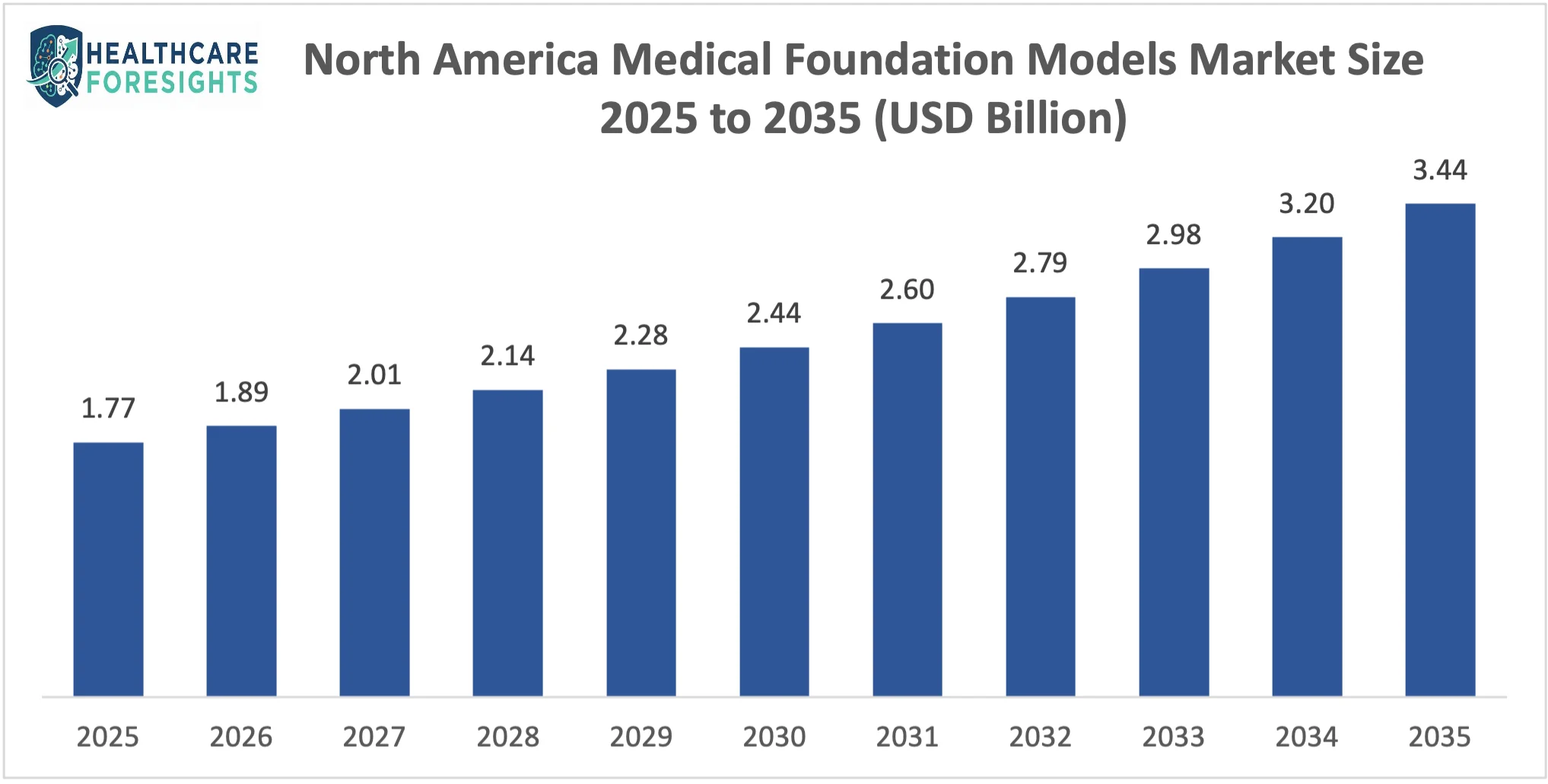
The North America Medical Foundation Models market size is forecast to reach USD 1.77 billion by 2025 and is expected to reach around USD 3.44 billion by 2035 with a CAGR of 6.84% from 2026 to 2035.
Why Did North America Dominate the Market in 2025?
North America's high number of hospitals, pharmaceutical, biotechnology, and research institutions in the region with extensive use of generative AI across these sectors and the advanced healthcare infrastructure and AI ecosystem made North America contribute around 44.8% to the global Medical Foundation Models market in 2025.
The United States is a major investor in precision medicine projects, cloud computing, multimodal AI, and large language models (LLMs). As key players in the AI industry, such as leading AI companies, healthcare organizations, and life sciences firms, continue to join the ecosystem, the adoption of EHRs and government initiatives promoting the proper use of AI are driving medical foundation models into clinical and research settings.
Why is Asia Pacific an Important and Growing Market?
The Asia Pacific Medical Foundation Models market is projected to witness the highest CAGR during the forecast period, as the healthcare sector has been undergoing digital transformation at a quick pace and investments are rising in precision medicine and biomedical research, along with the growth of AI infrastructure.
Governments in countries such as China, Japan, India, South Korea, Singapore, and Australia are all taking major steps to build up AI capacity in the healthcare sector, including the development of digital health policies, investments in cloud computing, and research into AI in healthcare. The foundation models' increasing usage and proposal for clinical decision support, medical imaging, drug discovery, and healthcare automation, coupled with the expanding healthcare datasets and a surge in pharmaceutical research and development, present significant growth prospects throughout the region.
What makes Europe a Strategically Important Market?
Medical Foundation Models have a strong market in Europe due to its well-developed healthcare infrastructure, existing trust in the healthcare system, and advanced biomedical research capabilities. Healthcare digital transformation, clinical artificial intelligence, and precision medicine programs are key focus areas for countries such as Germany, United Kingdom, France, Italy, Spain, Switzerland, and the Netherlands.
As the EU spotlights its advancements in medical imaging analysis, documentation, and research initiatives, such as the EU AI Fundamentals, along with the new AI rules, Europe's presence in the global medical imaging and personalized healthcare market has become increasingly pronounced.
What is driving the growth opportunity in Latin America?
Healthcare providers in Latin America are increasingly looking to these technologies to drive digital health infrastructure and are making significant investments in the region. As healthcare providers increasingly invest in digital health infrastructure and artificial intelligence technologies, Latin America is steadily emerging as a promising market. Multiple nations, such as Brazil, Mexico, Argentina, Chile, and Colombia, are investing in biomedical research initiatives and the adoption of healthcare IT and cloud-based services in order to enhance the clinical outcomes and healthcare delivery.
The rise in partnerships between AI technology vendors, pharmaceutical firms, academic institutions, and healthcare providers, as well as investments in precision medicine and clinical research, will likely boost the use of medical foundation models across the region.
Why Middle East & Africa is an Emerging Market?
Overall, the Middle East & Africa Medical Foundation Models market is growing slowly, driven by the growing emphasis on healthcare modernization, the use of AI in healthcare, and the implementation of national digital health strategies. In addition, many countries are investing in the use of AI in healthcare infrastructure, precision medicine projects, cloud computing, biomedical innovation, and other sectors.
At the same time, different countries are building up their assets for AI in healthcare, precision medicine, cloud computing, and biomedical innovations, among others. The partnerships between the sector and global tech companies, along with increasing investments in the healthcare sector, are expected to create significant long-term growth opportunities regionally as foundation models for clinical decision support, medical imaging, healthcare analytics, and research applications become more popular.
Key Market Players
Google LLC (Google DeepMind & Google Cloud)
Amazon Web Services (AWS)
OpenAI
Oracle Health (Oracle Corporation)
IBM Corporation (Watsonx Health)
GE HealthCare Technologies Inc.
Siemens Healthineers AG
Tempus AI Inc.
Aidoc Medical Ltd.
PathAI Inc.
Owkin Inc.
Insilico Medicine
Hippocratic AI
Others
Key Developments
Market Trends Have Seen Extensive Evolution As bio-isobutanol developers have moved to commercialize and diversify their product offerings, they have faced significant evolution in global markets for their bio-isobutanol derivatives within fuel, coatings, and paints markets.
June 2025 – Microsoft bolstered its healthcare artificial intelligence capabilities with new Medical Foundation Models on Azure AI that can enable multimodal clinical reasoning, automate medical documentation, and integrate with electronic health records (EHR), medical imaging systems, and healthcare workflows.
In April 2025, Google Cloud announced the availability of Medical Foundation Models, which expand the capabilities of its foundation models for generative AI in healthcare to enhance diagnostic accuracy, clinician productivity, and patient care in clinical documentation, medical imaging analysis, biomedical research, and precision medicine.
The Medical Foundation Models Market is segmented as follows:
By Model Type
Large Language Models (LLMs)
Multimodal Foundation Models
Vision Foundation Models
Biomedical Language Models
Protein & Molecular Foundation Models
Imaging Foundation Models
By Deployment Mode
Cloud
On-Premises
Hybrid
By Technology
Transformer-based Architectures
Generative AI
Large Language Models (LLMs)
Multimodal AI
Retrieval-Augmented Generation (RAG)
Federated Learning
Knowledge Graphs
Reinforcement Learning
Natural Language Processing (NLP)
Regional Coverage:
North America
U.S.
Canada
Mexico
Rest of North America
Europe
Germany
France
U.K.
Russia
Italy
Spain
Netherlands
Rest of Europe
Asia Pacific
China
Japan
India
New Zealand
Australia
South Korea
Taiwan
Rest of Asia Pacific
The Middle East & Africa
Saudi Arabia
UAE
Egypt
Kuwait
South Africa
Rest of the Middle East & Africa
Latin America
Brazil
Argentina
Rest of Latin America
Competitive Landscape
The market is characterized by intense competition among established players and emerging companies. Strategic partnerships, mergers and acquisitions, and product innovation are key strategies employed by market participants.
Key Market Players
Microsoft Corporation
Google LLC (Google DeepMind & Google Cloud)
Amazon Web Services (AWS)
NVIDIA Corporation
OpenAI
Oracle Health (Oracle Corporation)
IBM Corporation (watsonx Health)
GE HealthCare Technologies Inc.
Siemens Healthineers AG
Tempus AI Inc.
Aidoc Medical Ltd.
PathAI Inc.
Owkin Inc.
Insilico Medicine
Hippocratic AI
Others
Meet the Team
This report was prepared by our expert analysts with deep industry knowledge and research experience.

With over five years of experience in the dynamic field of market research, I am a seasoned Head of Client Relations at Custom Market Insights™, a leading provider of customized and data-driven market insights. As the head of this department, I oversee and manage all aspects of the client experience and relationships within the organization, ensuring client satisfaction, retention, and loyalty while driving business growth and profitability.