
Market Size and Growth
The global Medical Foundation Models market is projected to reach USD 4.18 billion in 2026 and is expected to expand at 16.9% CAGR to USD 18.76 billion by 2035.
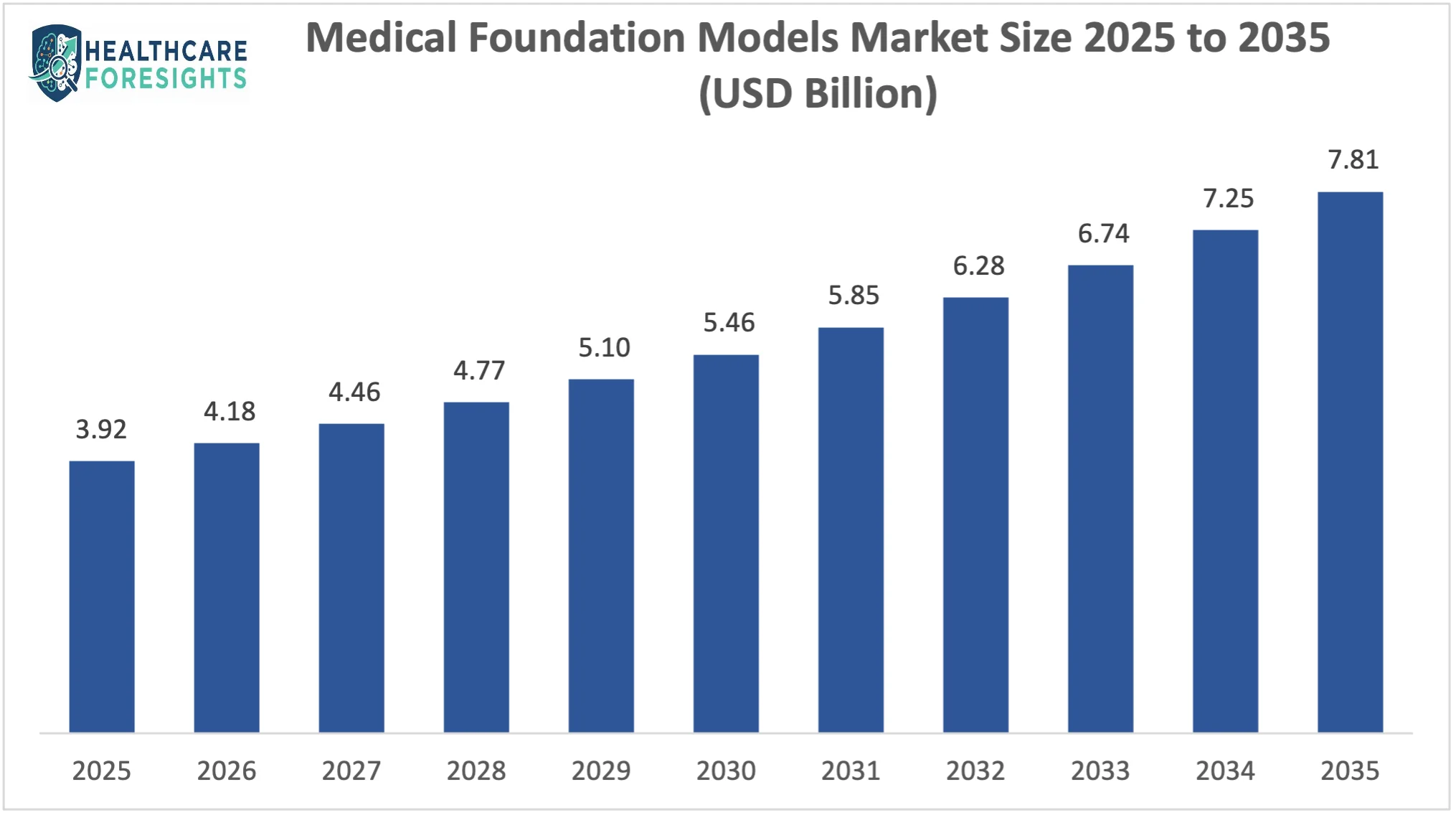
Global Medical Foundation Models Market Revenue and Trends
Market Size and Trends of Medical Foundation Models The market includes the deployment of cutting-edge AI technologies such as LLMs, multimodal AI models, transformer architectures, vision foundation models, genomic AI models, ML, and cloud-based AI infrastructure in the development of extensible healthcare intelligence solutions that are helping to reshape hospitals, pharmaceutical companies, biotechs, research organizations, and healthcare technology companies in the provision of sophisticated clinical decision support, analysis of medical imaging, drug discovery, biomedical research, customized patient treatments, automation of medical record-keeping, and healthcare data analysis.
Growing complexities in healthcare data, expansion in generative AI use in healthcare, the need for an enhanced, smart clinical automation system, increased spending on the development of drugs using AI, and increasing integration of foundation models in healthcare workflow are fueling significant growth of the Medical Foundation Models Market.
What are the Factors That Have a Significant Contribution to the Growth of the global Medical Foundation Models market?
The growing uptake of AI-based tools and services for various healthcare applications has accelerated the market's demand for medical foundation models capable of interpreting, managing, and analyzing complicated and heterogeneous medical data formats and modalities. Foundation models are extensively being utilized by the healthcare organizations to incorporate disparate data, including electronic health records (EHRs), radiology data, pathology results, genomic data, lab test reports, and biomedical literature to facilitate a wide range of tasks such as diagnosis, therapeutic planning, and decision-making. Growing demand for more efficient and cost-effective healthcare, minimizing diagnostic variability across different practitioners, speedy drug discovery, and personalized medicine are driving hospitals, drug manufacturers, and researchers to invest in AI platforms on a large scale.
Also, the rising need for AI in automating clinical documentation, diagnostic purposes, and the deployment of smart healthcare assistants creates ideal opportunities for market players. Emerging generative AI, LLMs, multimodal models, transformers, self-supervised learning, and AI infrastructure are making further contributions towards transforming the healthcare AI landscape.
Modern-day medical foundation models analyze a varied range of medical information, develop clinical understandings, contribute to clinical decisions, and assist drug discovery and personalized medical predictions. In the coming future, it is predicted that tech organizations, drug organizations, and hospitals, as well as academic institutions, would invest considerably in R&D associated with AI, as well as cloud computing facilities and precision medicine, to expand the medical foundations' market in the foreseen duration.
Opportunities Impact Analysis
Impact Factor | Estimated CAGR Impact | Regional Relevance | Market Impact |
Growing adoption of generative AI and large language models (LLMs) in healthcare | +3.7% | North America, Europe, Asia Pacific | Accelerates development of AI-powered clinical assistants, medical reasoning systems, and healthcare automation platforms |
Increasing demand for multimodal AI models integrating clinical, imaging, and genomic data | +3.2% | North America, Europe, Asia Pacific | Enables comprehensive healthcare insights by combining multiple data sources for diagnosis, research, and personalized medicine |
Rising adoption of AI-powered drug discovery and biomedical research platforms | +2.8% | North America, Europe, Asia Pacific | Improves target identification, molecular analysis, clinical research efficiency, and therapeutic development |
Expansion of cloud-based AI infrastructure and healthcare data platforms | +2.4% | North America, Europe, Global | Supports scalable model training, deployment, data processing, and enterprise-wide AI implementation |
Increasing investments in precision medicine and AI-enabled clinical decision support | +2.1% | North America, Europe, Asia Pacific | Drives adoption of foundation models for personalized treatment planning, diagnostics, and patient management |
Challenges Impact Analysis
Impact Factor | Estimated CAGR Impact | Regional Relevance | Market Impact |
Data privacy, security, and regulatory concerns related to healthcare AI models | -2.5% | Global | Limits adoption due to challenges in managing sensitive patient data and ensuring compliance with healthcare regulations |
High computational costs and infrastructure requirements for training large AI models | -2.2% | Global | Restricts adoption among smaller healthcare organizations due to significant GPU, storage, and operational expenses |
Limited availability of high-quality healthcare datasets for AI model training and validation | -1.9% | Global | Reduces model accuracy, scalability, and performance across diverse clinical applications |
Lack of standardized AI validation frameworks and clinical acceptance pathways | -1.6% | North America, Europe, Global | Delays regulatory approval and slows integration of foundation models into clinical workflows |
Shortage of AI specialists, healthcare data scientists, and machine learning experts | -1.4% | Asia Pacific, Latin America, Middle East & Africa | Creates implementation challenges and limits effective customization and deployment of healthcare AI models |
Segment Insight
By Model Type: Multimodal Foundation Models hold the largest share of the medical foundation models market, as they are capable of processing and interpreting various forms of data, including clinical notes, medical images, genomics, laboratory reports, and research literature. Medical foundation models that can generate holistic clinical insights and assist in disease diagnosis, precision medicine, and improve healthcare decision making are widely adopted in pharmaceutical companies, research institutions, and hospitals.
By Deployment Mode: Cloud held the largest share in the deployment modes segment due to its ability to deliver the necessary computing power and scalable infrastructure that support the training and deployment of the massive medical foundation models. Moreover, medical foundation model platforms in the cloud make it easy for them to integrate with EHRs, medical imaging systems, genomic databases, and healthcare analytics platforms, while helping in reducing overall expenses and making data accessible readily. The on-premise segment captured a significant share of the market in 2022, due to concerns related to data security and privacy for sensitive patient information in the healthcare industry.
By Technology: The Transformer-based Architectures segment is projected to record the highest growth rate during the forecast period as it helps analyze vast quantities of structured and unstructured healthcare data. Improvements to LLMs, vision transformers and multimodal AI architectures are also driving better and wider application of techniques such as natural language processing (NLP), generative AI, and multimodal reasoning in clinical trials, drug discovery, and diagnostic and precision healthcare applications.
Regional Analysis
North America is expected to be the largest market for medical foundation models in 2022, driven by the strong healthcare infrastructure and increasing adoption of artificial intelligence, as well as widespread usage of EHRs, and the ongoing healthcare AI initiatives by the countries in North America, particularly the United States and Canada. The market for medical foundation models is growing significantly due to large investments being made in the research area for precision medicine and in the development of new enterprise-scale AI solutions for research and clinical usage.
In 2022, the Asia Pacific region accounted for the fastest growing market for medical foundation models and is expected to grow at a significant rate during the forecast period owing to initiatives towards digitalization in the healthcare sector, increased spending on AI infrastructure, easy access to a vast amount of healthcare data, and rising use of new-age AI techniques by researchers and hospitals across countries like China, Japan, India, South Korea, Singapore, Australia, etc. They are making investments in advanced AI techniques and precision medicine solutions.
Report Scope
Feature of the Report | Details |
Market Size in 2026 | USD 4.18 billion |
Projected Market Size in 2035 | USD 18.76 billion |
Market Size in 2025 | USD 3.92 billion |
CAGR Growth Rate | 16.9% CAGR |
Base Year | 2025 |
Forecast Period | 2026-2035 |
Key Segment | By Model Type, Deployment Mode, Technology and Region |
Report Coverage | Revenue Estimation and Forecast, Company Profile, Competitive Landscape, Growth Factors and Recent Trends |
Regional Scope | North America, Europe, Asia Pacific, Middle East & Africa, and South & Central America |
Buying Options | Request tailored purchasing options to fulfil your requirements for research. |
Recent Developments
March 2025: IBM expanded the capabilities to its Watsonx. Governance platform including the automation of model risk management, increased AI lifecycle monitoring, and enhanced regulatory compliance so that healthcare and life sciences organizations can foster better transparency, auditability, and governability in enterprise AI applications.
List of the prominent players in the Medical Foundation Models Market:
Microsoft Corporation
Google LLC (Google DeepMind & Google Cloud)
Amazon Web Services (AWS)
NVIDIA Corporation
OpenAI
Oracle Health (Oracle Corporation)
IBM Corporation (Watsonx Health)
Aidoc Medical Ltd.
PathAI Inc.
Owkin Inc.
In Silico Medicine
Hippocratic AI
Others
The Medical Foundation Models Market is segmented as follows:
By Model Type
Large Language Models (LLMs)
Multimodal Foundation Models
Vision Foundation Models
Biomedical Language Models
Protein & Molecular Foundation Models
Imaging Foundation Models
By Deployment Mode
Cloud
On-Premises
Hybrid
By Technology
Transformer-based Architectures
Generative AI
Large Language Models (LLMs)
Multimodal AI
Retrieval-Augmented Generation (RAG)
Federated Learning
Knowledge Graphs
Reinforcement Learning
Natural Language Processing (NLP)
Regional Coverage:
North America
U.S.
Canada
Mexico
Rest of North America
Europe
Germany
France
U.K.
Russia
Italy
Spain
Netherlands
Rest of Europe
Asia Pacific
China
Japan
India
New Zealand
Australia
South Korea
Taiwan
Rest of Asia Pacific
The Middle East & Africa
Saudi Arabia
UAE
Egypt
Kuwait
South Africa
Rest of the Middle East & Africa
Latin America
Brazil
Argentina
Rest of Latin America