
Market Size and Growth
The healthcare knowledge graph market size was valued at USD 1.10 billion in 2026 and is anticipated to reach USD 2.26 billion by 2035 with a compound annual growth rate of 8.3% from 2026 to 2035.
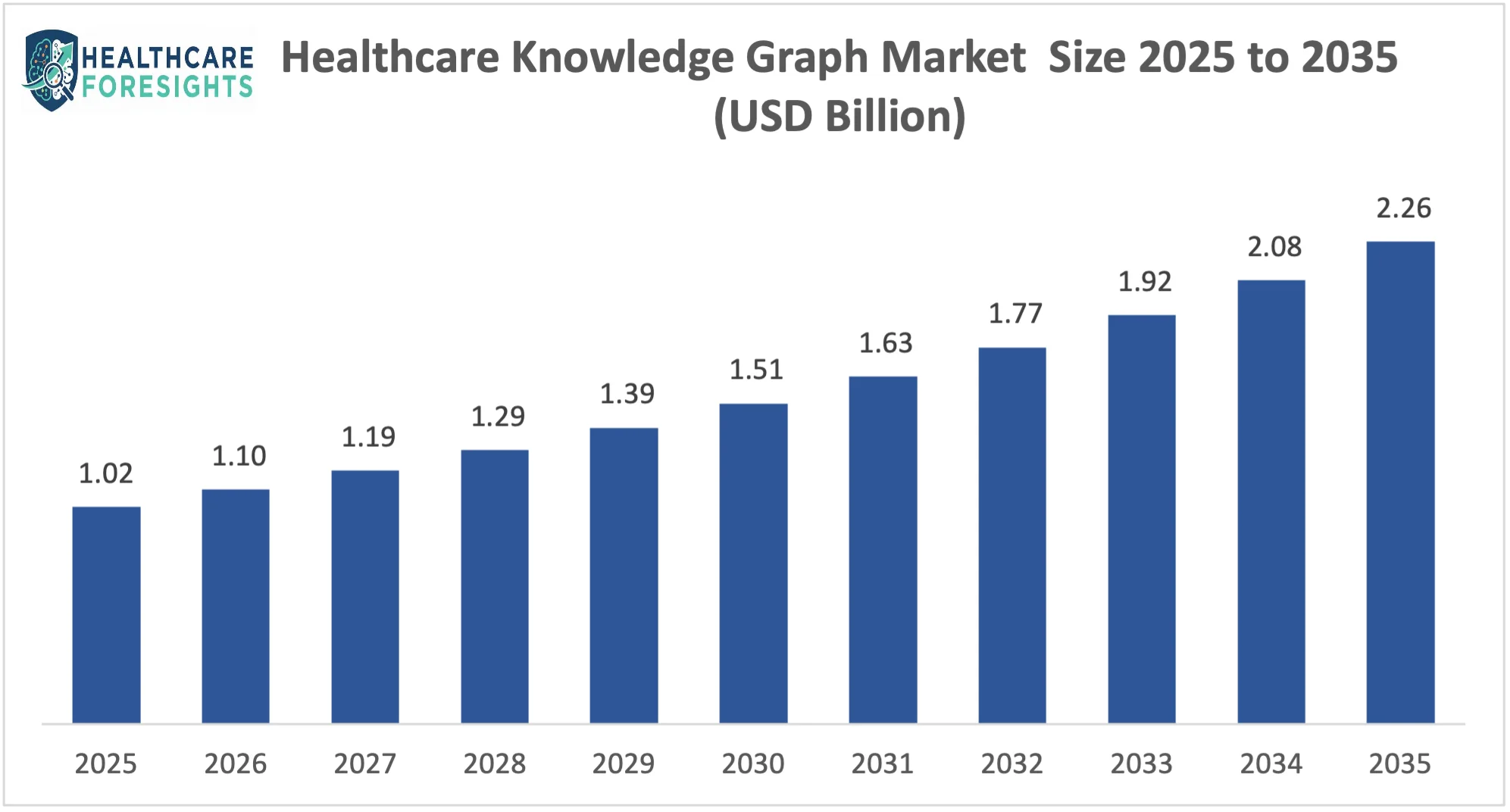
Global Healthcare Knowledge Graph Market Revenue and Trends
The healthcare knowledge graph market is defined by the implementation of knowledge graph technologies, graph databases, semantic web technologies, natural language processing (NLP), large language models (LLMs), graph neural networks (GNNs), artificial intelligence (AI), and data integration platforms for linking, managing, and analyzing large and intricate healthcare data.
The sector is revolutionizing hospitals, pharmaceutical companies, biotechnology corporations, research centers, healthcare providers, and life science enterprises with applications in smart clinical decision-making support, biomedical research, drug development, precision health, healthcare analytics, and interoperable data management. The healthcare knowledge graph market is seeing a substantial boom due to ever growing complexities in healthcare data, increasing uptake of AI based healthcare solutions, a surge in the need for data interoperability, the expansion of precision medicine, and a boost in digital health investment across the globe.
What are the Factors That Have a Significant Contribution to the Growth of the global Healthcare Knowledge Graph market?
The exponential rise in healthcare data volume contributes to market growth; healthcare providers are increasingly using knowledge graphs to connect and drive better decisions. The unprecedented surge in both structured and unstructured data generation by EMRs, genomic databases, medical imaging machines, clinical trials, published biomedical research papers, medical devices, wearable monitors, and real-world evidence has led to the growing need for the Healthcare Knowledge Graph (HKG) market. Healthcare organizations utilize HKGs to link diverse, siloed clinical, genomic, drug-related, and research information into integrated, semantic networks that enhance the decision-making process, improve patient diagnostic capabilities, aid in patient stratification, and ensure evidence-based treatments.
The escalating demand for tailored therapies, precision medicine approaches, novel drug discovery through drug repositioning, and advanced AI based clinical decision making is prompting investment in smart knowledge management platforms by pharmaceutical firms, research bodies and hospitals. Furthermore, growing adoption of healthcare interoperability standards, such as FHIR, and proliferation of digital healthcare transformation initiatives are augmenting the market expansion prospects.
Advancement of Technology Powering the HKG Landscape The advent of new generative AI models, LLMs, graph neural networks (GNNs), and semantic reasoning mechanisms is dramatically changing the HKG functionality, including improved access through mechanisms like Retrieval Augmented Generation (GraphRAG), and Cloud based Graph Databases are paving the way for massive data scale management, modern knowledge graph platforms can map intricate links across diseases, gene sequences, compounds, biomarkers, and a variety of other biomedical entities, thus expediting knowledge exploration, intuitive search queries, anticipatory analytics, and smart reasoning for AI supported decision making.
Heightened funding across healthcare providers, drug producers, technology providers, and research organizations for various innovative applications in areas of precision medicine, biomedicine and data driven AI in healthcare will significantly contribute to the rise of the Healthcare Knowledge Graph Market in the upcoming time frame.
Opportunities Impact Analysis
Impact Factor | Estimated CAGR Impact | Regional Relevance | Market Impact |
Growing adoption of AI-powered clinical decision support and precision medicine platforms | +3.6% | North America, Europe, Asia Pacific | Accelerates deployment of healthcare knowledge graphs for intelligent diagnostics, treatment recommendations, and personalized patient care |
Increasing integration of generative AI, large language models (LLMs), and GraphRAG technologies | +3.2% | North America, Europe, Asia Pacific | Enhances semantic search, automated medical reasoning, biomedical knowledge discovery, and clinical data interpretation |
Rising demand for healthcare interoperability, FHIR adoption, and unified data integration | +2.8% | North America, Europe, Global | Supports seamless integration of EHRs, clinical systems, genomic databases, and biomedical research repositories through interconnected knowledge graphs |
Expanding investments in precision medicine, genomics, and biomedical research | +2.4% | North America, Europe, Asia Pacific | Strengthens adoption of knowledge graphs for integrating genomic, molecular, clinical, and pharmaceutical data to support personalized healthcare |
Increasing pharmaceutical adoption of knowledge graphs for drug discovery and clinical research | +2.0% | North America, Europe, Asia Pacific | Improves target identification, biomarker discovery, drug repurposing, clinical trial optimization, and evidence generation |
Challenges Impact Analysis
Impact Factor | Estimated CAGR Impact | Regional Relevance | Market Impact |
Data privacy, security, and regulatory compliance challenges associated with healthcare data integration | -2.4% | Global | Limits large-scale deployment due to concerns regarding sensitive patient data protection and regulatory compliance |
Complexity of integrating heterogeneous healthcare data sources and legacy IT systems | -2.1% | Global | Slows implementation by creating challenges in connecting EHRs, laboratory systems, imaging platforms, and research databases |
High implementation costs and infrastructure requirements for enterprise knowledge graph platforms | -1.8% | Emerging Markets, Global | Restricts adoption among smaller healthcare providers and research organizations with limited technology budgets |
Shortage of skilled professionals in semantic technologies, graph databases, AI, and healthcare informatics | -1.5% | Asia Pacific, Latin America, Middle East & Africa | Delays development, deployment, and optimization of healthcare knowledge graph solutions |
Data quality, ontology standardization, and knowledge graph validation challenges | -1.3% | North America, Europe, Global | Reduces confidence in AI-driven clinical insights and limits interoperability across diverse healthcare ecosystems |
Segment Insight
By Knowledge Graph Type
Clinical Knowledge Graphs is the leading segment in the market and is driven by increased use across hospitals and healthcare systems to enhance patient care, improve clinical decision support, and power healthcare analytics. The use of clinical knowledge graphs to connect and unify disparate datasets like electronic health records (EHRs), patient history, medications, imaging, laboratory results, and clinical guidelines to create a unified semantic network has facilitated widespread adoption of these solutions in precision medicine and smart healthcare workflows.
By Deployment Mode
The cloud-based deployment segment is estimated to be the largest market and this is attributed to the ever-growing demand from enterprises for a scalable infrastructure for enterprise-wide healthcare data integration and the integration of AI driven analytics. These platforms allow for seamless interoperability with various healthcare solutions including EHR, laboratory systems, biomedical databases, and other AI enabled applications. Furthermore, cloud deployment options offer real-time collaboration capabilities and can potentially result in lower infrastructure costs, with flexibility in deploying in different healthcare settings.
By Technology
Graph Databases is the leading technology in the market and is growing due to its proficiency in handling complex, highly interconnected healthcare and biomedical data. It provides extensive support for semantic querying and relationship analysis and for enabling real-time traversal on graphs, thereby facilitating knowledge discovery and supporting various applications including drug discovery, clinical decision support, precision medicine and biomedical research.
Regional Insights
North America holds the largest share in the Healthcare Knowledge Graph market and is expected to hold a dominant position during the forecast period. North America is strongly supported by its well-established healthcare infrastructure, high degree of AI and digital health technology penetration, increasing investment in precision medicine, and the existence of major healthcare IT organizations, pharmaceutical and life sciences companies and various research institutions.
Increasing implementations of the interconnected healthcare data platforms and advanced AI driven clinical decision support systems in North America continue to drive demand for these solutions. Asia Pacific is expected to register the highest growth rate over the forecast period, with its expansion primarily attributed to the fast-growing healthcare digital transformations, widening healthcare IT infrastructure, expanding AI adoption in healthcare, and an increasing adoption of precision medicine solutions.
Factors such as significant investments in research & development and large-scale adoption of precision medicine are driving the implementation of healthcare knowledge graphs by organizations in China, Japan, India, South Korea, Singapore, and Australia, creating substantial long-term opportunities.
Report Scope
Feature of the Report | Details |
Market Size in 2026 | USD 1.10 billion |
Projected Market Size in 2035 | USD 2.26 billion |
Market Size in 2025 | USD 1.02 billion |
CAGR Growth Rate | 8.3% CAGR |
Base Year | 2025 |
Forecast Period | 2026-2035 |
Key Segment | By Knowledge Graph Type, Deployment Mode, Technology and Region |
Report Coverage | Revenue Estimation and Forecast, Company Profile, Competitive Landscape, Growth Factors and Recent Trends |
Regional Scope | North America, Europe, Asia Pacific, Middle East & Africa, and South & Central America |
Buying Options | Request tailored purchasing options to fulfil your requirements for research. |
Recent Developments
In June 2025: Elsevier B.V. deepened its Life Sciences Intelligence portfolio by unveiling its upgraded AI-driven knowledge graph to link biomedical literature, clinical evidence, genomic information and real-world evidence to enable effective drug discovery, clinical research and evidence-based healthcare.
List of the prominent players in the Healthcare Knowledge Graph Market:
Oracle Corporation
Neo4j Inc.
Elsevier B.V.
Wolters Kluwer N.V.
Microsoft Corporation
Stardog Union Inc.
Ontotext (Progress Software)
Cambridge Semantics Inc.
Franz Inc.
Semantic Web Company GmbH
Clarivate Plc.
Others
The Healthcare Knowledge Graph Market is segmented as follows:
By Knowledge Graph Type
Clinical Knowledge Graphs
Biomedical Knowledge Graphs
Pharmaceutical Knowledge Graphs
Genomic & Precision Medicine Knowledge Graphs
Healthcare Enterprise Knowledge Graphs
Research & Scientific Knowledge Graphs
By Deployment Mode
Cloud
On-premises
Hybrid
By Technology
Graph Databases
Semantic Web Technologies (RDF, OWL, SPARQL)
Graph Neural Networks (GNNs)
Natural Language Processing (NLP)
Large Language Models (LLMs) Integration
Knowledge Representation & Reasoning
Retrieval-Augmented Generation (GraphRAG)
Regional Coverage:
North America
U.S.
Canada
Mexico
Rest of North America
Europe
Germany
France
U.K.
Russia
Italy
Spain
Netherlands
Rest of Europe
Asia Pacific
China
Japan
India
New Zealand
Australia
South Korea
Taiwan
Rest of Asia Pacific
The Middle East & Africa
Saudi Arabia
UAE
Egypt
Kuwait
South Africa
Rest of the Middle East & Africa
Latin America
Brazil
Argentina
Rest of Latin America