
Market Size and Growth
The market size of the global stem cell culture media will be estimated at USD 765 million in 2025 and is expected to grow to between USD 868 million in 2026 and about USD 2714 million by 2035 with a current CAGR of 13.5% during the period of 2026 to 2035.
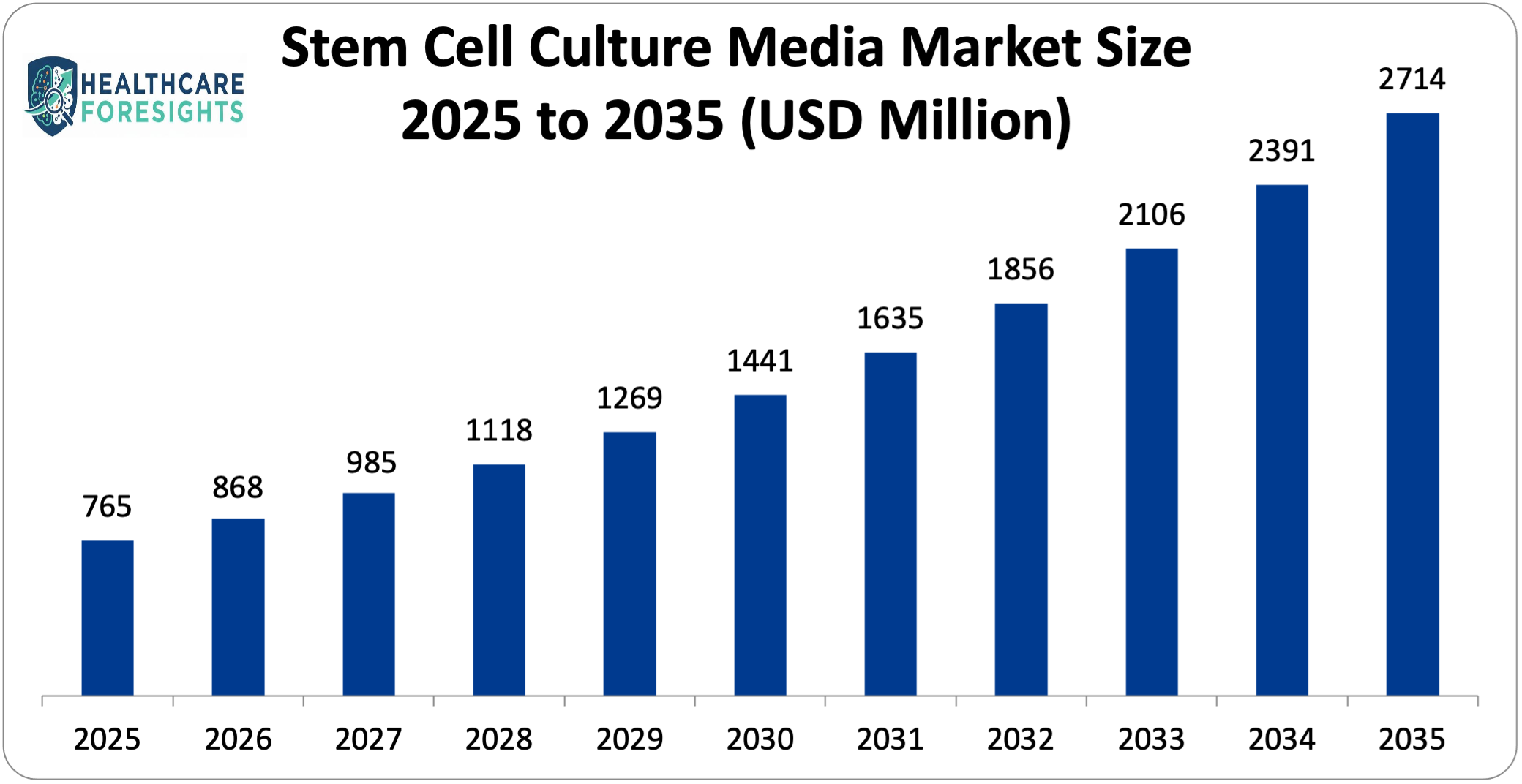
Stem Cell Culture Media Market Revenue and Trends
Stem cell culture media are specialized nutrient-rich solutions that enable scientists to grow stem cells while keeping them in their original undifferentiated state. These media serve as essential components for stem cell research because they create the natural body environment that stem cells require to grow outside their natural body environment. The product consists of a basic medium that provides essential nutrients such as amino acids, vitamins, salts, and glucose together with particular growth factors and serum or serum alternatives and antioxidants that maintain the cells' ability to become various cell types.
What are the Factors That Have a Significant Contribution to the Growth of the Stem Cell Culture Media Market?
Market expansion occurs because new stem cell media products provide better stem cell research methods which enable researchers to collect and analyze test results. Current market trends have moved away from traditional serum-based media products because researchers now prefer serum-free, xeno-free, and chemically defined media products which eliminate animal-derived component variability and provide better batch consistency. The research process requires these standards to produce consistent results, which must also satisfy the mandatory testing requirements used in clinical trials and commercial product development.
The development of formulation science enables scientists to create specialized media that support particular cell types and specific research purposes, including media designed for mesenchymal stem cells and induced pluripotent stem cells and hematopoietic stem cells and neural stem cells. The customized media solutions, which scientists developed, enable researchers to improve cell viability, expansion rates, and differentiation control, which results in shorter culture times and decreased production expenses. The stem cell performance improvement, which scientists achieved, results from combining recombinant growth factors with small-molecule supplements and metabolic optimization, while the method decreases requirements for costly and unstable biological materials.
Segment Insight
By End-Use
The pharmaceutical and biotechnology companies segment is growing at a significant rate over the projected period. The growth is driven by the increasing integration of stem cell technologies into drug discovery, development, and advanced therapeutic pipelines. The demand for high-quality reproducible application-specific culture media has increased because pharmaceutical and biotechnology companies use stem cell-derived models and organoids to validate targets and conduct toxicity screening and efficacy testing. Revenue growth depends on the expansion of cell and gene therapy programs which need GMP-grade scalable regulatory-compliant media for both clinical and commercial production.
Regional Insights
North America held the highest market share in 2025. The rising research and development investments together with the transition to serum-free and chemically defined formulations and the requirement to decrease late-stage drug failures, which drive the implementation of advanced stem cell culture media, create a growing market demand that benefits pharmaceutical and biotechnology companies.
Besides, the Asia Pacific market has the highest rate of growth in the stem cell culture media market. The increasing number of clinical trials combined with the emergence of cell therapy startups and the expansion of CROs/CDMOs creates greater demand for scalable reliable media solutions which need to meet GMP-grade standards. The adoption of stem cell technologies and research infrastructure improvements, together with reduced operational expenses, lead to continuous market growth throughout the Asia Pacific region.
Report Scope
Feature of the Report | Details |
Market Size in 2026 | USD 868 Million |
Projected Market Size in 2035 | USD 2714 Million |
Market Size in 2025 | USD (2025 Value) Million |
CAGR Growth Rate | 13.5% CAGR |
Base Year | 2025 |
Forecast Period | 2026-2035 |
Key Segment | By Type, Application, End-Use and Region |
Report Coverage | Revenue Estimation and Forecast, Company Profile, Competitive Landscape, Growth Factors and Recent Trends |
Regional Scope | North America, Europe, Asia Pacific, Middle East & Africa, and South & Central America |
Buying Options | Request tailored purchasing options to fulfil your requirements for research. |
Recent Developments
In July 2024, Specialist bioactive protein manufacturer Qkine announced a new partnership with StemCultures, a life sciences company dedicated to developing innovative reagents that enhance the quality and efficiency of cell growth and differentiation in culture. The partnership between Qkine and StemCultures combines Qkine's expertise in protein manufacturing and engineering with StemCultures' proprietary technology for controlled-release systems to create new stem cell expansion and differentiation research reagents. (Source: https://qkine.com/2024/07/09/stemcultures-qkine-product-development-collaboration/)
List of the prominent players in the Stem Cell Culture Media Market:
Sartorius AG
Cytiva
Corning Incorporated
STEMCELL Technologies Inc.
FUJIFILM Irvine Scientific Inc.
Miltenyi Biotec B.V. & Co. KG
Biological Industries Ltd.
CellGenix GmbH
Thermo Fisher Scientific Inc.
HiMedia Laboratories Pvt. Ltd.
Merck KGaA
Others
The Stem Cell Culture Media Market is segmented as follows:
By Type
Mesenchymal Stem Cells (MSCs)
Embryonic Stem Cells (ESCs)
Induced Pluripotent Stem Cells (iPSCs)
Hematopoietic Stem Cells (HSCs)
Others
By Application
Drug Discovery & Development
Tissue Engineering & Regenerative Medicine
Stem Cell Therapy Manufacturing
By End-Use
Pharmaceutical & Biotechnology Companies
Hospitals & Transplant Centers
CDMOs & CROs
Stem Cell Banks/Biobanks
Academic & Research Institutes
Regional Coverage:
North America
U.S.
Canada
Mexico
Rest of North America
Europe
Germany
France
U.K.
Russia
Italy
Spain
Netherlands
Rest of Europe
Asia Pacific
China
Japan
India
New Zealand
Australia
South Korea
Taiwan
Rest of Asia Pacific
The Middle East & Africa
Saudi Arabia
UAE
Egypt
Kuwait
South Africa
Rest of the Middle East & Africa
Latin America
Brazil
Argentina
Rest of Latin America