
Market Size and Growth
The clinical mass spectrometry market in the world is estimated to be USD 4.37 billion in 2025 and is projected to grow to USD 4.86 billion by 2026 and about USD 11.43 billion by 2035 at a CAGR of 8.9% between 2026 and 2035.
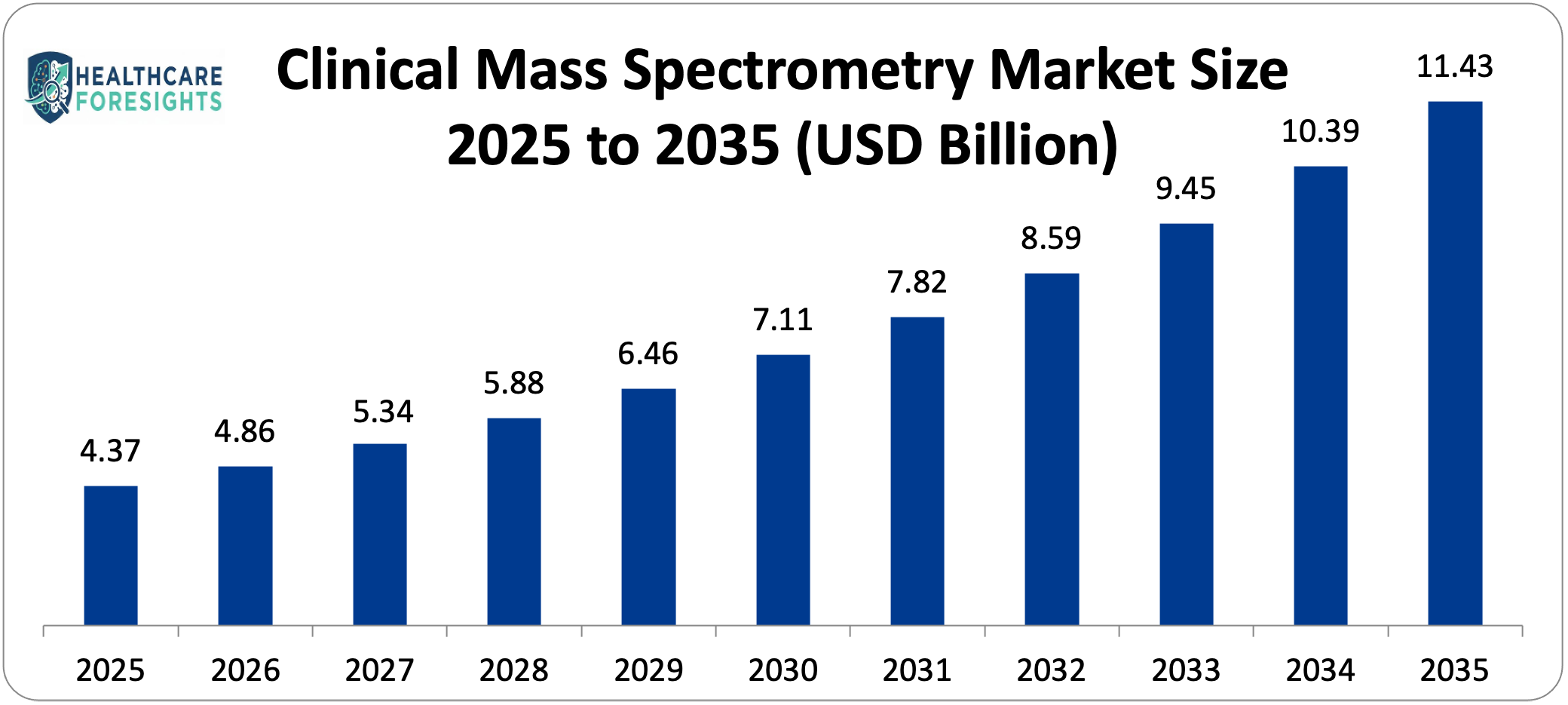
Clinical Mass Spectrometry Market Revenue and Trends
The clinical mass spectrometry market has high-end analytical tools like liquid chromatography-mass spectrometry (LC-MS/MS), gas chromatography-mass spectrometry (GC-MS), matrix-assisted laser desorption/ionization time-of-flight (MALDI-TOF), and high-resolution mass spectrometers with clinical diagnostics, including therapeutic drug monitoring, toxicology screening, endocrinology testing, neonatal metabolism screening, and pathogen identification for hospitals and reference laboratories.
The mass spectrometry clinical market is expanding fast in the world due to the rising use of precision diagnostics, growing cases of chronic illnesses and infectious epidemics, personalized medicine, a growing number of clinical lab networks, and high-throughput, automated, and portable mass spectrometry systems across the globe.
What are the factors that have a significant contribution to the growth of the clinical mass spectrometry market?
The increase in demand for very sensitive and multiplexing assays of biomarker detection and drug level monitoring, due to rising numbers of chronic conditions such as diabetes and cancer that affect billions of people around the world and the requirement of rapid and accurate results in point-of-care, has increased its adoption.
MS-based tests are now considered to be more specific to vitamin D, steroids, and immunosuppressants than immunoassays, leading to regulatory approvals and lab integrations. With the change of healthcare towards prevention and individualized treatment, clinicians are in search of effective tools that can decrease the risks of misdiagnosis and maximize the effectiveness of treatment.
Technological advances have brought automated sample preparation processes, AI-enhanced data analysis, miniaturized benchtop systems to standard laboratory environments, and hybrid data collection with a wider range of analyte detection, enhanced turnaround, sensitivity, and usability. Other factors are the growing concern with antimicrobial resistance testing, enhancement of reimbursement of MS diagnostics, and government programs that finance the clinical research and modernization of labs in both established and new markets.
Segment Insight
By Product Type
LC-MS/MS systems had the biggest share in the clinical mass spectrometry market as of 2025, driven by the need to perform quantitative analysis in therapeutic drug monitoring, endocrinology, and toxicology. They are needed in high-precision metabolite profiling and pharmacokinetic experiments, and the development has been robust due to advances in triple quadrupole designs with improved selectivity and throughput (which is generally considered by lab directors to be critical to simplify the workflow and guarantee compliance in large-scale clinical testing).
By Distribution Channel
Direct sales through the manufacturer have the greatest market share and are the primary channel to customized installations, validation services, and continuing support. They are the channel of choice because they offer specialized technique development, regulatory reports, and combined training of the hospitals, diagnostic laboratories, and reference centers that process complicated diagnostic processes, which are regulated and are of significant stakes.
Regional Insights
The mass spectrometry market in North America is the largest in the world because of excellent clinical laboratory facilities, widespread implementation of MS in routine diagnostics, massive investment in research and development by NIH and commercial businesses, and positive reimbursement policies. The area has a large presence of instrument suppliers, a rich network of reference laboratories, and early adoption of MS in newborn screening that leads to sustained innovation and the standardization of the procedures.
The Asia pacific region on the other hand, has the highest future growth in the clinical mass spectrometry market due to the rapidly growing healthcare systems, the rising chronic disease burden, the growing medical tourism, and the growing investment in the diagnostic capabilities. Countries such as China, India, and Japan are also experiencing an increment in the use of cost-effective automated MS systems, with the assistance of government health schemes, domestic productions, and technological transfer alliances. The process of urbanization, aging, and attention to the surveillance of infectious diseases also stimulates the growth of the market in Asia Pacific.
Report Scope
Feature of the Report | Details |
Market Size in 2026 | USD 4.86 billion |
Projected Market Size in 2035 | USD 11.43 billion |
Market Size in 2025 | USD 4.37 billion |
CAGR Growth Rate | 8.9% CAGR |
Base Year | 2025 |
Forecast Period | 2026-2035 |
Key Segment | By Product Type, Application, End-User and Region |
Report Coverage | Revenue Estimation and Forecast, Company Profile, Competitive Landscape, Growth Factors and Recent Trends |
Regional Scope | North America, Europe, Asia Pacific, Middle East & Africa, and South & Central America |
Buying Options | Request tailored purchasing options to fulfil your requirements for research. |
Recent Developments
In October 2025: Waters Corporation introduced the Xevo MRT (multi-reactionary monitoring) mass spectrometer as a clinical device, which includes AI-optimal MRM transitions to allow rapid clinical therapeutic drug monitoring and enhanced sensitivity in low-volume samples.
List of the prominent players in the Clinical Mass Spectrometry Market :
Waters Corporation
Sciex (Danaher Corporation)
Shimadzu Corporation
PerkinElmer Inc. (Revvity)
JEOL Ltd.
bioMérieux SA
Beckman Coulter Inc. (Danaher)
Others
The Clinical Mass Spectrometry Market is segmented as follows:
By Product Type
Liquid Chromatography-Mass Spectrometry (LC-MS/MS, Triple Quadrupole)
Gas Chromatography-Mass Spectrometry (GC-MS, GC-MS/MS)
Inductively Coupled Plasma Mass Spectrometry (ICP-MS)
High-Resolution Mass Spectrometry (Orbitrap, QTOF)
Other Product Types (Tandem MS for Newborn Screening, Direct MS)
By Application
Therapeutic Drug Monitoring (Immunosuppressants, Antiepileptics, Oncology Drugs)
Toxicology & Drug Testing (Clinical Toxicology, Workplace Drug Testing, Forensic)
Newborn Screening (Inborn Errors of Metabolism, Amino Acids, Acylcarnitines)
Endocrinology & Hormone Testing (Steroids, Thyroid Hormones, Reproductive Hormones)
Vitamin & Nutritional Biomarker Testing (Vitamin D, B12, Folate, Fat-Soluble Vitamins)
Infectious Disease Testing (Antiviral Drug Monitoring, Antimicrobial Stewardship)
Oncology Biomarker Testing
Other Applications (Proteomics, Metabolomics, Heavy Metals)
By End-User
Hospital & Clinical Laboratories
Reference Laboratories (National and Commercial Reference Labs)
Pharmaceutical & Biotechnology Companies
Academic & Research Institutes
Forensic & Government Laboratories
Other End-Users
Regional Coverage:
North America
U.S.
Canada
Mexico
Rest of North America
Europe
Germany
France
U.K.
Russia
Italy
Spain
Netherlands
Rest of Europe
Asia Pacific
China
Japan
India
New Zealand
Australia
South Korea
Taiwan
Rest of Asia Pacific
The Middle East & Africa
Saudi Arabia
UAE
Egypt
Kuwait
South Africa
Rest of the Middle East & Africa
Latin America
Brazil
Argentina
Rest of Latin America