
Market Size and Growth
The global AI voice agents in the healthcare market value are estimated at USD 2.14 billion in 2025 and projected to move between USD 2.68 billion in 2026 and USD 14.37 billion in 2035 with an increase of 18.3% in the period between 2026-2035.
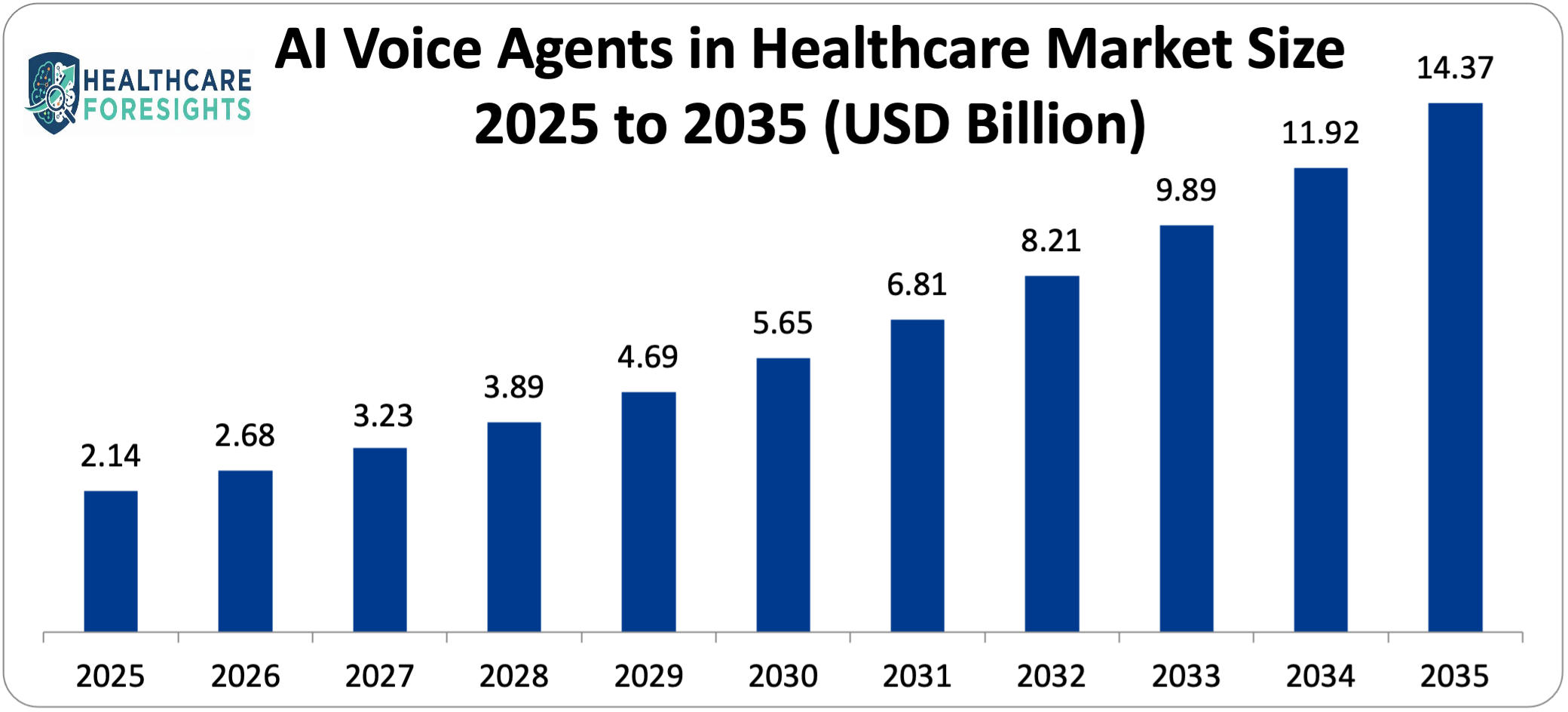
AI Voice Agents in Healthcare Market Revenue and Trends
The AI voice agent market in the healthcare sector includes intelligent conversational systems that run on natural language processing (NLP) and speech recognition as well as machine learning and are applied in healthcare to patient triage, schedule appointments, check symptoms, remind patients to take their medication, provide virtual nursing, and offer administrative support in hospitals, clinics, telehealth, and home care. The world AI voice agent market is expanding at an alarming rate and is mainly propelled by the increasing use of telemedicine, the necessity to manage chronic diseases, the need to decrease the healthcare workforce, the increasing patient engagement demands, and the developments of multilingual, context-sensitive voice AI combined with electronic health records (EHRs) and Internet of things (IoT) devices all over the world.
What are the Factors That Have a Significant Contribution to the Growth of AI voice agents in the healthcare market?
This has increased adoption due to the boom in demand for the accessible, 24/7-patient interaction tools, which were stimulated by the growth of remote monitoring after the pandemic, aging populations needing chronic care, and attempts to decrease administrative workload on clinicians. Industry reports claim that AI voice agents are able to process up to 80% of simple requests leaving employees free to deal with complex tasks to enhance efficiency in operations. With the increase in healthcare costs and the expansion of digital health literacy, there is a need to find a scaled solution to deliver personalized voice-based care and meet the accessibility requirements.
Emotion-detecting NLP, secure voice biometrics to authenticate users, smooth EHR interconnections, and hybrid human-AI handovers have been introduced by technological innovations, making it more accurate, private, and trusted by the user. Other motivators are augmented interest in value-based care models, enhanced wearable interoperability, and government programs that fund digital health innovations in the developed and new markets.
Segment Insight
By Product Type
Conversational AI platforms, which comprised the largest portion of the AI voice agents in the healthcare market as of 2025, were driven by the need to have an all-purpose, cloud-based system that allows conducting natural conversations to perform triage, reminders, and virtual consultations. These channels are vital to front-office patient support as well as workflow automation and have a steep rise due to real-time translation and sentiment analysis innovations (which most providers consider essential to enhance engagement and minimize the rate of no-show among various patient groups).
By Distribution Channel
The direct sales made by technology providers have the highest market share, and it is the main channel of customized deployments, API integrations, compliance support, and subscription models. Such channels offer professional implementation support, data security audits, and hospital-specific configurations, which is why they are the option of choice among healthcare organizations that have regulated and patient-centric digital interactions.
Regional Insights
North America is the world leader in AI voice agents in healthcare market because of developed telehealth systems, high uptake of digital health technologies in large hospitals, large investment in AI startups, and robust HIPAA-compliant systems. The market is characterized by a high level of innovators, extensive use of EHR, and the early adoption of voice AI in the management of chronic care, which contributes to the continuous improvement and scalability of the region.
In the meantime, the Asia Pacific region is the most rapidly expanding market of AI voice agents in healthcare, due to the development of the digital health industry, the large number of patients, the increase of smartphone usage, and the governmental initiatives to provide accessible medical services in the country. Investments, public-private collaboration, and localization are driving the growing adoption of multilingual, low-cost voice agents in countries such as China, India, and Japan. Asia Pacific is in further market growth acceleration due to urbanization, growth of telemedicine and emphasis on elderly care.
Report Scope
Feature of the Report | Details |
Market Size in 2026 | USD 2.68 billion |
Projected Market Size in 2035 | USD 14.37 billion |
Market Size in 2025 | USD 2.14 billion |
CAGR Growth Rate | 18.3% CAGR |
Base Year | 2025 |
Forecast Period | 2026-2035 |
Key Segment | By Component, Technology, Application, End-User and Region |
Report Coverage | Revenue Estimation and Forecast, Company Profile, Competitive Landscape, Growth Factors and Recent Trends |
Regional Scope | North America, Europe, Asia Pacific, Middle East & Africa, and South & Central America |
Buying Options | Request tailored purchasing options to fulfil your requirements for research. |
Recent Developments
In November 2025: Nuance (a Microsoft company) introduced a new version of Dragon Ambient eXperience (DAX) healthcare voice agent and applied generative AI to provide real time clinical history and patient summaries during a virtual visit, which had 30 times higher accuracy.
List of the prominent players in the AI Voice Agents in Healthcare Market:
Abridge AI Inc.
Ambience Healthcare Inc.
Amazon Web Services Inc.
Google LLC (Google Health)
Oracle Health
Orbita Inc.
Augnito (Scribetech)
Others
The AI Voice Agents in Healthcare Market is segmented as follows:
By Component
Software (AI Voice Agent Platforms, NLP Engines, Clinical Documentation Software)
Hardware (Smart Speakers, Microphone Arrays, Edge Computing Devices)
Services (Implementation, Integration, Training, Managed Services)
By Technology
Natural Language Processing (NLP)
Automatic Speech Recognition (ASR)
Text-to-Speech (TTS)
Large Language Models (LLMs)
Other Technologies (Speaker Diarization, Sentiment Analysis)
By Application
Clinical Documentation & Transcription (Ambient Clinical Intelligence)
Patient Engagement & Virtual Assistants
Diagnostic Support
Medication Management & Adherence
Appointment Scheduling & Administrative Automation
Remote Patient Monitoring Support
Other Applications (Training Simulation, Medical Education)
By End-User
Hospitals & Health Systems
Ambulatory Care Centers & Physician Practices
Home Healthcare & Remote Monitoring Programs
Pharmaceutical Companies & Clinical Trials
Payers & Health Plans
Other End-Users
Regional Coverage:
North America
U.S.
Canada
Mexico
Rest of North America
Europe
Germany
France
U.K.
Russia
Italy
Spain
Netherlands
Rest of Europe
Asia Pacific
China
Japan
India
New Zealand
Australia
South Korea
Taiwan
Rest of Asia Pacific
The Middle East & Africa
Saudi Arabia
UAE
Egypt
Kuwait
South Africa
Rest of the Middle East & Africa
Latin America
Brazil
Argentina
Rest of Latin America