Systemic sclerosis has always been difficult to explain neatly, even for physicians who treat it regularly. Some patients mainly deal with skin thickening and circulation problems. Others develop lung complications early. In some cases, symptoms progress slowly over the years. In others, things change much faster than expected. That unpredictability is part of what has made the disease so frustrating for both patients and clinicians.
For a long time, treatment discussions mostly revolved around managing symptoms, slowing progression where possible, and trying to stay ahead of complications before they became severe. Now, though, researchers are starting to look at the disease differently.
There is growing interest in whether systemic sclerosis can be tracked earlier, monitored more precisely, and eventually treated in a way that feels less generalized from patient to patient.
The Challenge Has Never Been Just One Symptom
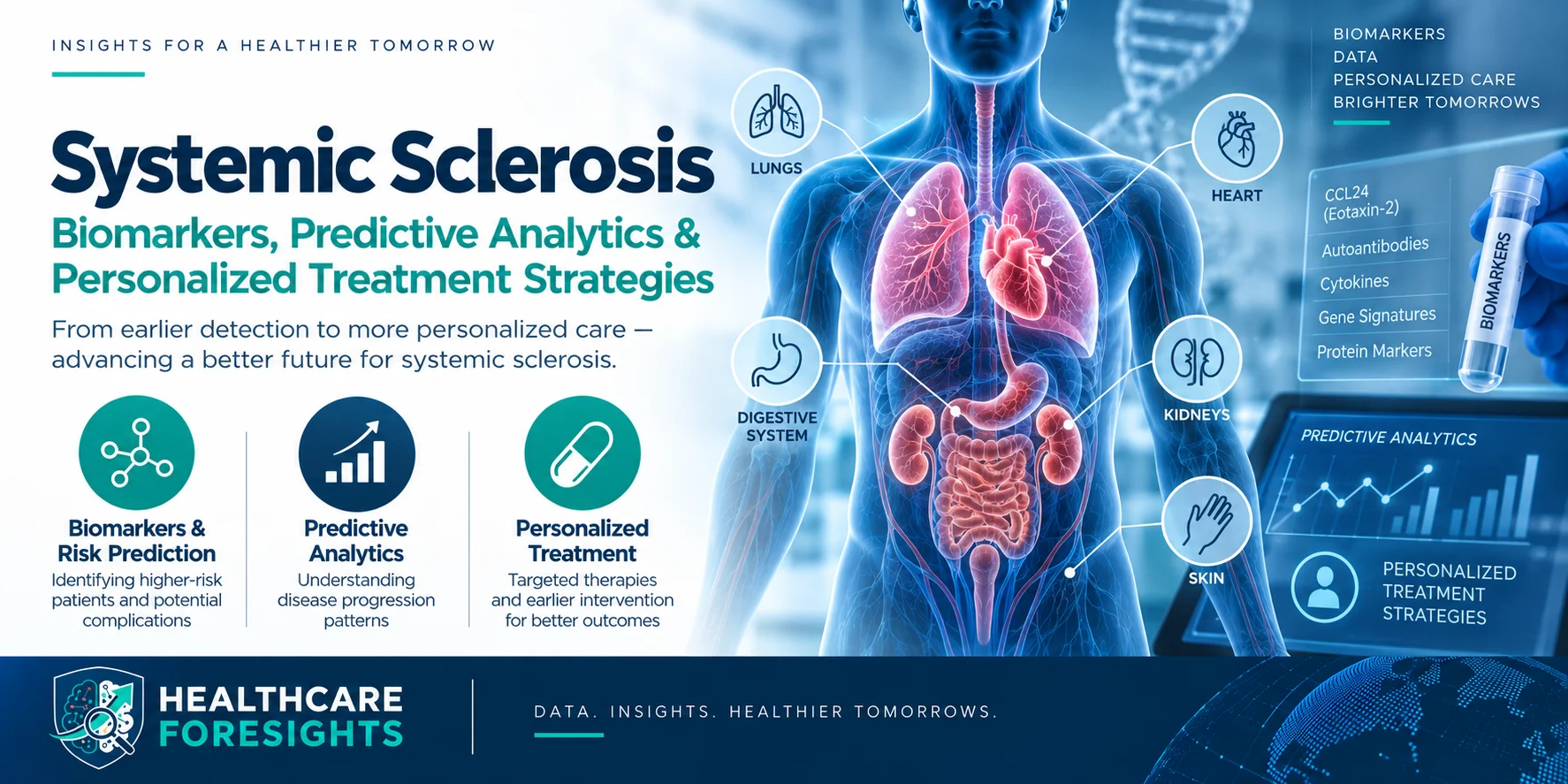
One rheumatologist described systemic sclerosis during a discussion as “a disease that rarely stays in one lane.” That description actually captures the problem fairly well. Even though the condition is often associated with skin changes, the bigger concern is usually what may be happening internally. The lungs, digestive system, kidneys, and heart can all become involved over time, which makes monitoring complicated.
And because progression does not look identical in every patient, doctors often have to make treatment decisions without having a perfectly clear picture of what the disease will do next.
That uncertainty is why researchers are putting so much effort into finding better markers for progression.
Why Biomarker Research Matters So Much
A lot of recent attention has gone toward serum CCL24, also called Eotaxin-2. Researchers are studying whether higher levels may be connected to complications like interstitial lung disease and digital ulcers, both of which can seriously affect quality of life. What makes this important is not just the science itself. It is the possibility that doctors could eventually identify higher-risk patients earlier instead of waiting for visible deterioration.
Several clinicians said that earlier prediction would completely change how treatment planning works in systemic sclerosis. Right now, many treatment adjustments happen after progression becomes clearer clinically. Better biomarkers could potentially shift that timing forward.
Clinical Trials Feel More Encouraging Than They Did Before
Doctors working in autoimmune disease research also mentioned that the overall tone around systemic sclerosis studies has changed somewhat in recent years. There is still caution, obviously. Nobody is describing this as a solved problem. But there is more optimism around targeted therapies and earlier intervention strategies than there used to be.
The CONQUEST trial, which focuses on systemic sclerosis patients with interstitial lung disease, came up often during discussions because lung involvement remains one of the most serious aspects of the disease.
Several physicians said the larger significance is not only the trial itself but also the fact that more focused research efforts are happening consistently now. That was not always the case in rare autoimmune diseases.
Technology Is Quietly Entering the Conversation Too
Another area getting attention is predictive modeling. Researchers are using computational approaches to study progression patterns and identify trends that may not be obvious during standard clinical follow-up.
The idea is straightforward in theory: if physicians can better estimate how the disease is likely to behave over time, treatment decisions become more proactive.
Whether these tools become widely used clinically is still unclear. But many specialists believe predictive models will eventually become part of how complex autoimmune diseases are monitored.
Treatment Discussions Are Becoming More Individualized
One thing that stood out repeatedly in conversations with clinicians was how strongly the field is moving toward personalized care. Doctors are increasingly thinking about which patients are likely to benefit from specific therapies, which patients may progress faster, and how treatment intensity should differ depending on disease behavior.
That broader movement toward precision medicine is happening across healthcare generally, but systemic sclerosis may benefit from it more than most conditions because variability between patients is so significant.
Healthcare advisory and research organizations such as CMI Consulting LLC are also seeing increased focus on how rare disease research, predictive analytics, and personalized treatment strategies are beginning to intersect more closely.
There Is Still a Long Way to Go
Nobody involved in this space seems to believe systemic sclerosis care is close to being simple. The disease remains complicated. Treatment can still involve a lot of uncertainty. And many patients continue to face serious long-term challenges. But compared to where the field stood years ago, the direction does feel different now.
Researchers understand more about progression than they once did. Physicians have more tools available. And there is finally growing momentum around earlier detection and more targeted intervention. For patients living with systemic sclerosis, even that shift alone matters.